
Peacefull Warrior: Lessons for Barrel Racing
- Feb 1
- 3 min read
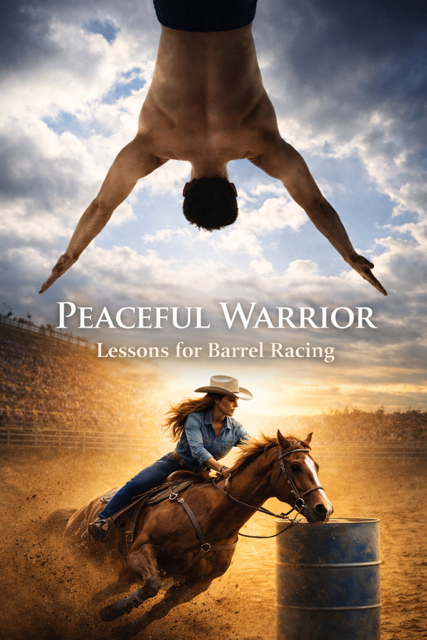
How the Rider’s Mind Defines the Run Before the Horse Enters the Pattern
The movie Peaceful Warrior is not just a story about gymnastics; it is a deep reflection on mental discipline, focus, fear, ego, and purpose. Although it takes place in the world of Olympic sports, its lessons fit surprisingly well and powerfully into the world of barrel racing.
In this sport—where every fraction of a second counts and where horse and rider must move as one—the real competition is not always in the arena… many times, it is in the mind.
1. The Invisible Battle: The Competitor’s Mind
In Peaceful Warrior, Socrates teaches Dan that his greatest enemy is not the bar, but his own mind: the fear of failure, the pressure to win, and attachment to results.
The same thing happens in barrel racing. Many riders lose the run before they even enter the pattern, trapped in thoughts like:
“I can’t knock this barrel over.”
“I have to beat…”
“If I fail, I’ll disappoint everyone.”
That mental noise is transmitted to the horse—through the hands, the seat, the breathing. A horse can feel your insecurity, tension, or urgency. The film reminds us that a centered rider creates a more confident horse.
Mastering the mind is just as important as mastering technique.
2. Only This Moment Exists
One of the central messages of the movie is that the only real moment is the present. It’s not the barrel you already hit, not the previous time, and not the fear of the next barrel.
In barrel racing, when the rider stays mentally at the first barrel, the second one is already lost. When the rider thinks about the time before finishing, the rhythm is already broken.
The best runs happen when the rider enters a state where there is no crowd, no stopwatch, and no fear. There is only the horse, the breathing, the rhythm, and the pattern.
The best run is not the fastest one; it is the most conscious one.
3. Ego vs. Purpose
Dan begins wanting medals. Socrates teaches him to seek mastery.
In barrel racing, it’s easy for ego to take control: comparisons, rivalry, obsession with prizes. But when the focus shifts from winning to growing, something changes:
The rider listens more to the horse
The process is respected
Even a “bad run” becomes a lesson
The true champion is not the one who always wins, but the one who is always evolving.
4. The Horse as a Mirror
In Peaceful Warrior, the body reflects what the mind hides. In barrel racing, the horse is that mirror.
A tense horse almost always carries a tense rider. The horse reflects what the rider carries inside.
When the rider works on calmness and intention, the horse responds—not only physically,
but emotionally.
Before training the horse more, train your presence more.
5. Running as a Path of Growth, Not Just Competition
The movie turns sport into a path of self-discovery. Every run can be an exercise in focus, a practice in trust, and a lesson in humility.
Not every day will be a fast time, but every day can be a day of progress.
Every run is an opportunity to become a better rider and a better version of yourself.
From Peaceful Warrior, we learn that true victory is not found on the podium, but in inner mastery. Barrel races are not won by speed alone; they are won with presence, confidence, and a mind trained to stay in the now.
Remember: the strongest warrior is not the most aggressive, but the most conscious.
When the rider runs in peace, the horse runs with freedom. And when both are fully present in the moment, the pattern flows.
And it is there that we finally understand that the best runs are not the ones that look the fastest, but the ones that feel the most complete.
We invite you to read the book or watch the movie "The Peaceful Warrior".


Comments